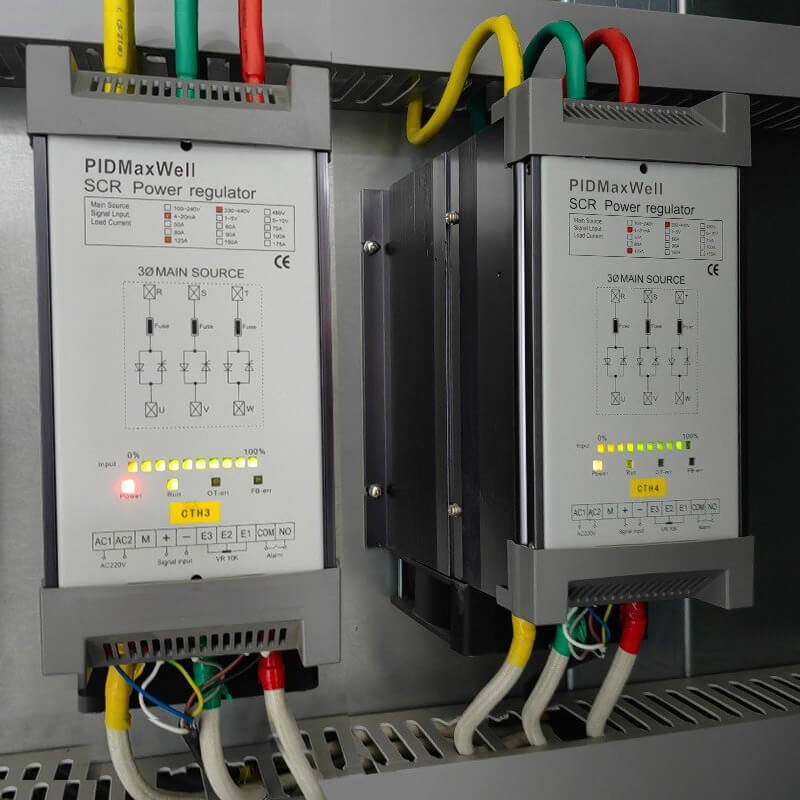
In selecting components for industrial heating equipment, customers often bring us samples of power regulators and ask: "Can this directly control the temperature? If I buy it and connect it to the heating element, will it automatically maintain a constant temperature?" This question is very common. Many customers, when first encountering a power regulator, habitually confuse its function with that of a temperature controller. Today, we'll break this down and clarify it based on several practical questions that customers care about most. What exactly am I buying when I buy a power regulator? A power regulator is a power regulation device, not a temperature measurement device. Its core component is a SCR (Silicon Controlled Rectifier), which receives an external analog signal (such as 4-20mA or 0-10V) and then adjusts the voltage or current output to the heating element based on the signal strength. It doesn't know the temperature, nor does it d...
In industrial electric heating systems, a power regulator is typically installed between the temperature controller (or PLC) and the heater. It does not generate heat itself, nor does it measure temperature; instead, it receives control signals and adjusts the actual voltage, current, or power delivered to the heating load. Many people wonder: just how useful is it? Is it mandatory for every heating application? There is no one-size-fits-all answer; it depends on factors such as equipment power, temperature control precision, load characteristics, and process requirements. For a low-power warming cabinet requiring only simple on/off switching—where a temperature variance of a few degrees is acceptable and switching frequency is low—relays, contactors, or even solid-state relays suffice for control. In such cases, adding a power regulator would merely increase costs and system complexity without offering significant benefits. Conversely, for equipment involving high-power he...