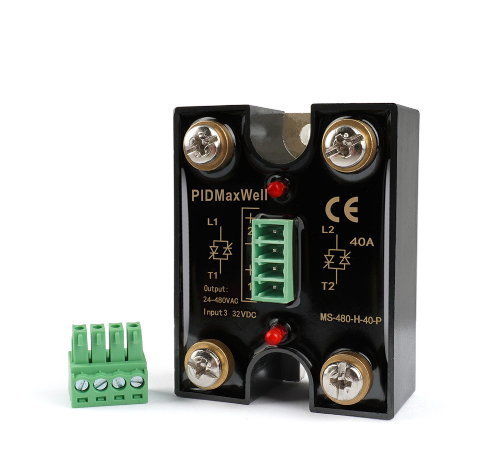
Many people may not be aware that there are limitations to the use of solid-state relays. Compared to mechanical solid-state relays, the limitations of solid-state relays are fewer, specifically as follows: Because solid-state relays are based on semiconductors, they cannot be fully turned on or off. This means that in the "on" state, when current flows, the solid-state relay still has internal resistance, causing it to heat up. In the "off" state, the solid-state relay still has a small leakage current, typically a few milliamps. This leakage current can be used to prevent certain loads from turning off, especially with high impedance. Furthermore, solid-state relays are very sensitive to voltage transients. Although Opto22 relays have excellent transient protection, they can still be damaged or have their performance degraded if subjected to a sufficient number of shocks. This makes solid-state relays less than ideal for driving large inductive electromechanical loads, such as some s...