-
Tel : +86-592-6382791
-
Email : sales@pidmaxwell.com
Tel : +86-592-6382791
Email : sales@pidmaxwell.com


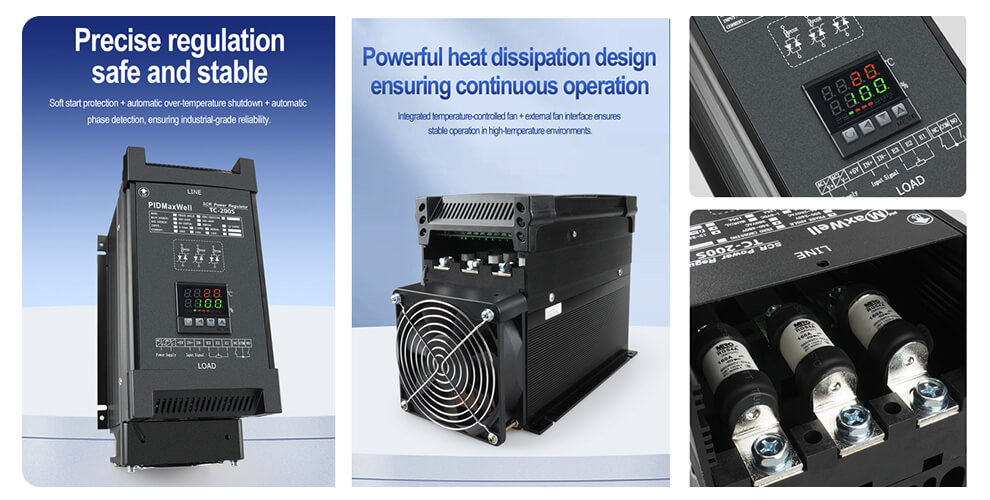
I. What problems does a power regulator solve?
The core function of a power regulator is to continuously regulate the output power of the electric heating equipment.
Take an industrial oven as an example: starting from room temperature, it needs to heat up to the set temperature and then maintain a constant temperature. If it heats at full power continuously, the temperature can easily overshoot; if only a regular switch is used for intermittent on/off switching, the temperature will fluctuate, resulting in unsatisfactory temperature control.
A power regulator allows the heating power to continuously change according to the actual temperature demand, making the heating and temperature stabilization processes smoother and effectively reducing temperature fluctuations.
II. Where does it fit in the temperature control system?
In a complete temperature control system, each component has its specific function:
The temperature controller detects the temperature and makes a judgment;
The power regulator receives control signals and executes power output;
The heating element converts electrical energy into heat.
After the temperature controller outputs a control signal, the power regulator adjusts the output power in real time based on this signal. In short, a power regulator is the key component that transforms "control commands" into "actual heating power."
III. How to Understand its Working Principle?
A power regulator typically uses a silicon controlled rectifier (SCR) as its core component to control the output of alternating current.
It adjusts the average power received by the load by changing the conduction angle or conduction period of the SCR:
When the system requires more heat, the power regulator increases the output;
When the temperature approaches the set value, it gradually reduces the output;
When the temperature is too high, the output will further decrease or even temporarily shut off.
This regulation method achieves continuous power variation, rather than a binary "on or off" choice.
IV. Why is it more suitable for stable temperature control than a contactor?
When controlling heating, a contactor only has two states: "fully on" and "fully off." This is acceptable for some less demanding equipment, but in high-power or high-precision temperature control applications, this method easily causes large temperature fluctuations, affecting product quality and equipment efficiency.
Power regulators can proportionally adjust power, ensuring a smooth transition in the heating process rather than sudden full on or off.
Therefore, they are more suitable for applications requiring stable temperature control, such as industrial ovens, electric furnaces, heat treatment equipment, packaging heating, and plastics machinery.
V. In which situations are power regulators used?
Power regulators are widely used in industrial equipment requiring stable heating, commonly including:
Industrial ovens, tunnel furnaces, heat treatment furnaces
Infrared heating equipment, hot air circulation equipment
Plastics machinery, packaging machinery
Glass equipment, ceramic kilns
Chemical heating equipment, etc.
These devices often share a common characteristic: high heating power and processes requiring a certain degree of temperature stability.
VI. Can power regulators save energy?
Strictly speaking, power regulators themselves are not "energy-saving wonders." The energy required for heating ultimately depends on the process temperature, equipment insulation performance, material characteristics, and production cycle time.
However, they can effectively reduce temperature overshoot and ineffective heating time, making power output more reasonable and precise. If existing equipment experiences significant temperature fluctuations, introducing a power regulator can often improve energy management and prevent unnecessary power waste.
VII. What should be considered during selection and installation?
When selecting a power regulator, it's necessary to confirm its compatibility with the load power, power supply type, and control signal. Different types of loads (such as ordinary heating elements, resistance wires, infrared lamps, silicon carbide rods, transformer loads, etc.) may have different control requirements.
During installation, the following should also be noted:
Ensure good heat dissipation to avoid prolonged high-temperature operation;
Main circuit terminals must be securely tightened to prevent overheating due to poor contact;
Control signal lines should be routed separately from power lines to reduce interference.
The value of a power regulator lies not in simply "switching" heating, but in enabling heating power to automatically and continuously change according to temperature demand. It helps industrial heating equipment upgrade from simple on/off control to more stable power regulation control, thereby improving temperature control accuracy and process consistency.
If you are struggling with equipment selection or temperature control issues, follow PIDMaxWell. We are willing to start from practical applications, help you sort out your needs, and reasonably match solutions so that every unit of electricity is used where it is most needed.

Address : NO.201 Binhuyili, HaiCang district, XiaMen,FuJian, China 361026
Max liao: +8618150368619(whatsapp)
Email : sales@pidmaxwell.com
Scan via wechat

Scan to Whatsapp