-
Tel : +86-592-6382791
-
Email : sales@pidmaxwell.com
Tel : +86-592-6382791
Email : sales@pidmaxwell.com


Many people have the same question when they encounter power regulators: Can this thing be used to directly control temperature? At first glance, it seems logical, since power regulators regulate power, and changes in power will naturally change the temperature. But if you look closely, the answer is actually quite clear—it doesn't inherently have the ability to "control temperature." What truly stabilizes the temperature at the set value is a series of interconnected systems.
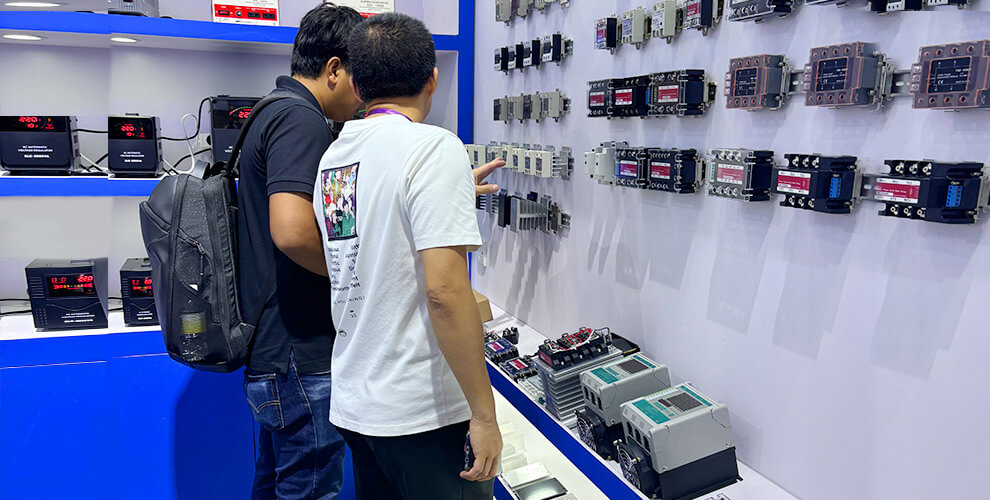
The power regulator in a circuit acts more like a compliant executor. It has no eyes or brain; it can't understand temperature signals from thermocouples or RTDs, nor can it compare the current temperature with the set value. Its only function is to obediently adjust the electrical output to the heating element according to external instructions. In other words, it can influence the intensity of heating, but it cannot determine when to heat or at what temperature to stop.
So who makes the decisions? Usually, it's a dedicated temperature control instrument, commonly known as a thermostat. This instrument is the "decision-making center" of the entire system. On one hand, it's connected to a temperature sensor, reading the actual temperature of the object being heated in real time; on the other hand, it stores the user-set target value. The instrument constantly calculates the deviation between the actual and target values—if the temperature is too low, it increases the control signal; if the temperature is close, it gradually decreases the signal; if the temperature exceeds the target, it may even directly cut off the output. In short, all instructions regarding "whether to heat and how much power to add" originate from this instrument.
However, a problem arises: while the thermostat can calculate and make judgments, its output signal is often only a few volts or tens of milliamps, which is insufficient to drive a high-power heating element. This is where the power regulator comes in. It acts like a power amplifier, converting the weak signal from the thermostat (such as 0-10 volts or 4-20 milliamps) into a high-power output capable of driving the thyristor. By adjusting the conduction angle or the zero-crossing trigger ratio, it smoothly changes the effective voltage across the heating element, thus achieving stepless power regulation. Therefore, the power regulator does the "labor" work; it simply translates the commands into actual electrical energy delivery.
The heating element itself is even simpler; it only converts electricity into heat, neither detecting temperature nor adjusting itself. Without the first two stages, it would continuously generate heat until the temperature becomes dangerously high or even burns out. Therefore, the heating element is merely the "heating end," lacking any autonomy.
Connecting these four parts in series forms an automatically operating closed loop. Sensors continuously measure the actual temperature and transmit it to the temperature controller. The temperature controller calculates the deviation and sends a control signal. The power regulator adjusts the power according to the signal. The heating element generates heat, changing the temperature, and then the new temperature is captured by the sensor and fed back again. This cycle may repeat many times per second, and the temperature stabilizes in this dynamic equilibrium.
Some might ask, since the thermostat can determine the load, why not directly use it to drive the heating element? The reason is simple: most thermostats have very weak output capacity. Directly connecting them to a high-power load would not only burn out the internal circuitry but also pose a serious fire hazard. Conversely, if only a power regulator is used without a thermostat, a fixed power value must be manually set, turning the system into an open-loop system. Changes in external conditions will cause significant temperature fluctuations, making constant temperature control impossible. Therefore, both are indispensable, along with a suitable sensor and heating element, to form a reliable temperature control system.
In practical engineering, several details require special attention. First, the signal type output by the thermostat must be consistent with the input requirements of the power regulator; current, voltage, and pulse signals cannot be mixed. Second, the rated current of the power regulator should have a margin, ideally more than 1.2 times the full-load current of the heating element, and attention should be paid to heat dissipation. Third, the temperature sensor must be installed in a location that accurately reflects the process temperature. It shouldn't be too close to or too far from the heating source; otherwise, the displayed value may not match the actual material temperature, leading to a situation where the reading appears accurate but the actual temperature is off.
In short, the power regulator alone cannot control the temperature; it's merely the power execution link in the entire chain. The temperature controller is truly responsible for decision-making, the sensor is responsible for sensing, and the heating element is responsible for heat generation. These four components are interconnected and work together to achieve accurate and stable temperature control. Once you understand this division of labor, the answer to the initial question becomes clear.

Address : NO.201 Binhuyili, HaiCang district, XiaMen,FuJian, China 361026
Max liao: +8618150368619(whatsapp)
Email : sales@pidmaxwell.com
Scan via wechat

Scan to Whatsapp