-
Tel : +86-592-6382791
-
Email : sales@pidmaxwell.com
Tel : +86-592-6382791
Email : sales@pidmaxwell.com


How a Modbus TCP/IP RS-485 temperature controller can fit into a Energy management system(EMS) in solar industrial ?
EMS(Energy management system) is the brain of solar system for household, when the solar generates excessive power and that excessive power should be well perserved, one of the approach woud be direct the excessive power to water heater. Here’s how a PID controller fits into and enhances a solar-powered EMS system.
Basically when EMS sees extra power, it will give command to Temperature controller via modbus TCP/IP and heat up water.
PID-Based Control: EMS → Temperature Setpoint (°C) → PID Controller (as Intelligent Regulator) → Heater
The PID controller is no longer just a dumb power valve; it becomes a smart, autonomous agent managing a thermal process, with the EMS acting as a supervisor that optimizes the agent's goals based on solar availability.
The EMS elevates the PID controller from a standalone device to a grid-aware, optimized system component.
1. Dynamic Setpoint Adjustment (Most Common Strategy)
Scenario: The EMS forecasts high PV production for the next 4 hours.
Action: The EMS raises the PID setpoint on the main boiler from 55°C to 65°C (or the maximum safe limit).
Result: The PID controller now works harder to reach this new, higher target. It calls for more power, more often, precisely coinciding with the solar surplus. When PV drops, the EMS lowers the setpoint to conserve the stored heat.
2. PV-Boost / "ECO" Mode Activation
Scenario: The EMS detects real-time excess PV power (> 1kW export).
Action: The EMS writes a digital command to the PID controller to enable a special "PV-Boost" mode.
Controller Logic: In this mode, the PID's output is clamped to the available excess power (calculated by the EMS or an internal power meter). The PID still regulates, but its power demand is limited to the surplus, preventing grid import.
3. Load Shedding & Grid Frequency Support (Advanced)
Scenario: Grid frequency drops (high demand), or the site's total power consumption nears its grid limit.
Action: EMS sends a command to temporarily disable the PID controller's output or severely limit its maximum output power.
Result: The thermal load is shed within seconds, supporting grid stability or avoiding peak demand charges. The PID process pauses and resumes when permitted, with minimal temperature drop due to the system's thermal mass.
4. Time-of-Use (TOU) Optimization
Scenario: Electricity prices will spike from 5 PM to 8 PM.
Action: EMS commands the PID to ensure the boiler reaches its maximum allowable temperature by 4:45 PM using cheap solar or off-peak power.
Result: From 5-8 PM, the heater can be turned off completely, and the stored hot water is used, avoiding expensive grid electricity.
Process Stability & Quality: PID ensures precise, stable temperatures critical for industrial processes (e.g., solar-powered cleaning, pasteurization, chemical reactions) or domestic comfort (no scalding).
Autonomous Operation: The PID handles all complex real-time adjustments to counteract disturbances (e.g., cold water inlet, ambient loss). The EMS only needs to intervene periodically to adjust goals.
Leverages Thermal Mass: The PID, guided by the EMS, can intelligently "charge" the thermal storage (water tank, buffer) when energy is cheap/abundant and "coast" when it is not.
Safety Integration: Built-in high/low limits, sensor break detection, and alarm relays provide a robust safety layer that a simple power regulator lacks.
Multi-Zone Management: A single multi-channel PID can manage different zones (e.g., DHW boiler, space heating buffer, pool) with different setpoints and priorities, all coordinated by the EMS.
EMS is the Strategist: It answers "When?" and "How much?" based on energy economics and grid conditions.
"We have excess solar for 3 hours – let's heat the tank to its max."
"Grid prices are high now – stop heating immediately."
PID Controller is the Tactician: It answers "How?" to achieve the thermal goal efficiently and safely.
"To reach 65°C, I'll apply full power now, then taper off to 30% as we approach the setpoint to avoid overshoot."
"A large draw of cold water just occurred. I'll increase power output by 15% to compensate."
In the solar industry, integrating a PID temperature controller with an EMS creates a powerful, two-layer optimization system. It marries grid and economic intelligence with precise process control. This is essential for applications beyond simple diversion, such as:
Solar thermal plants with storage.
PV-powered industrial heating/cooling processes.
Advanced residential/commercial solar thermal systems.
Combined heat and power (CHP) optimization.
The EMS guides the PID controller's objectives, turning a standard temperature loop into a dynamic, grid-responsive asset that maximizes self-consumption, minimizes costs, and can even provide grid services.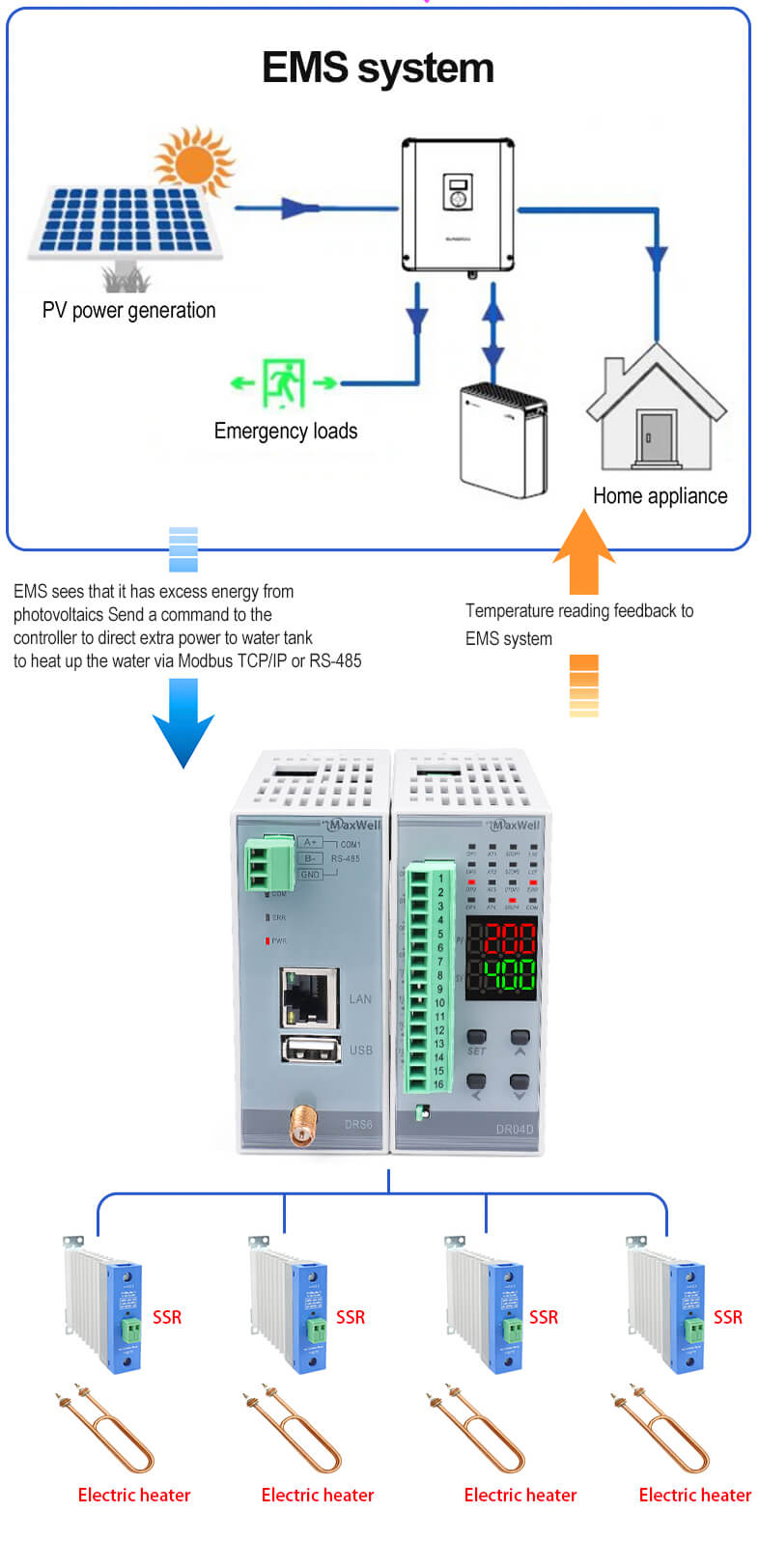

Address : NO.201 Binhuyili, HaiCang district, XiaMen,FuJian, China 361026
Max liao: +8618150368619(whatsapp)
Email : sales@pidmaxwell.com
Scan via wechat

Scan to Whatsapp